Sweden: ‘God Jul!’

Most people in Scandinavian countries honor St. Lucia (also known as St. Lucy) each year on December 13. The celebration of St. Lucia Day began in Sweden, but had spread to Denmark and Finland by the mid-19th century.
In these countries, the holiday is considered the beginning of the Christmas season and, as such, is sometimes referred to as “little Yule.” Traditionally, the oldest daughter in each family rises early and wakes each of her family members, dressed in a long, white gown with a red sash, and wearing a crown made of twigs with nine lighted candles. For the day, she is called “Lussi” or “Lussibruden” (Lucy bride). The family then eats breakfast in a room lighted with candles.
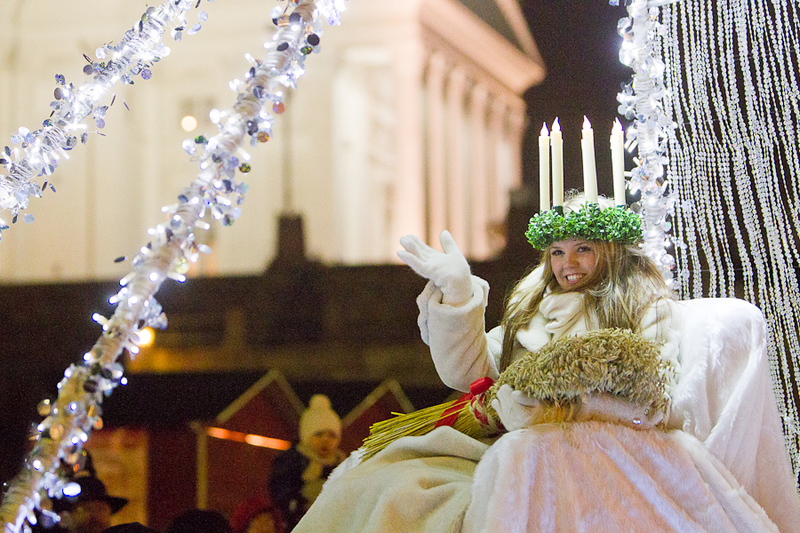
Any shooting or fishing done on St. Lucia Day was done by torchlight, and people brightly illuminated their homes. At night, men, women and children would carry torches in a parade. The night would end when everyone threw their torches onto a large pile of straw, creating a huge bonfire. In Finland today, one girl is chosen to serve as the national Lucia and she is honored in a parade in which she is surrounded by torchbearers.
Light is a main theme of St. Lucia Day as her name, which is derived from the Latin word lux, means light. Her feast day is celebrated near the shortest day of the year, when the sun’s light again begins to strengthen. Lucia lived in Syracuse during the fourth century when persecution of Christians was common. Unfortunately, most of her story has been lost over the years. According to one common legend, Lucia lost her eyes while being tortured by a Diocletian for her Christian beliefs. Others say she may have plucked her own eyes out to protest the poor treatment of Christians. Lucia is the patron saint of the blind.
Original Source: https://www.history.com/topics/christmas/christmas-traditions-worldwide