Idun - Norse Spring Goddess
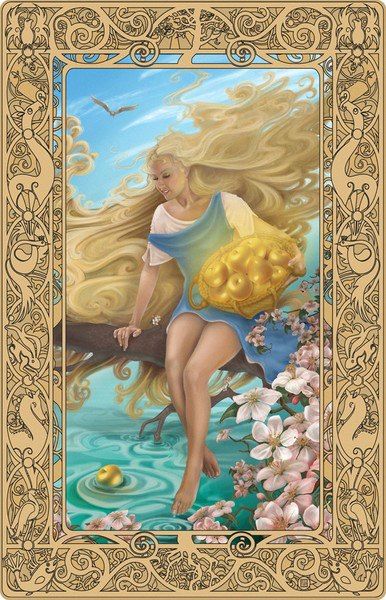
Idun, also spelled Idunn, or Iduna, in Norse mythology, the goddess of spring or rejuvenation and the wife of Bragi, the god of poetry. She was the keeper of the magic apples of immortality, which the gods must eat to preserve their youth. When, through the cunning of Loki, the trickster god, she and her apples were seized by the giant Thiassi and taken to the realm of the giants, the gods quickly began to grow old. They then forced Loki to rescue Idun, which he did by taking the form of a falcon, changing Idun into a nut (in some sources, a sparrow), and flying off with her in his claws.
Idunna (Iona or Ionna) is the Norse Goddess of innocence, fertility & death. She was the custodian of golden apples which allowed the Aesir gods to maintain their youth. Loki arranged for the cretin Thjazi to abduct her, but then was forced to get her back, a deed which ended in Thjazi’s death. Apples are one of the oldest and holiest symbols of life and rebirth among the Germanic folk, appearing as grave gifts from the Bronze Age onward. The Troth’s quarterly journal is named after this goddess.
Will the Real Loki Please Stand Up? by Magdelan Vertes
Has Loki, the Norse “Trickster” god, been misrepresented as an evil, scheming character, who was even considered by early Christians to be another face of the devil? Or does Loki have his roots as a much more ancient god, concerned with the balance of nature? It seems that Loki has all the attributes to suggest the latter. first, Loki’s name may have been derived from the Sanskrit “Loka”, meaning a spirit undergoing karma – spiritual enlightenment through repeated reincarnation. Loki, depicted as a handsome, agile little man, with a pointed laughing face, piercing blue eyes, and voluminous flame-red hair in curly locks, possesses sky shoes in which he can travel, with great speed, over land, sea and air – suggesting that he is connected with spirit flight (also being called the Sky Traveler) – and therefore has shamanic roots. Also, Loki is the most prominent shape shifter in the mythological cycle – yet another shamanic trait. Loki does not shape shift in any evolutionary order – which may disprove the theory that earthly evolution is a material representation of karma – a belief common among many ancient peoples (suck as the Hindus and Druids). Despite their lack of science and technology, the non-classical peoples were in fact, as can be seen by their religious theories and practices, much more perceptive about their environment, both in worldly and other-worldly matters, than is often believed.
What can be deduced in general from this information, therefore, is that Loki’s true form presides over and represents the true and pure spirit form – the other form he takes, the bodies the spirit resides in on the earth during karma – for the only way that one can shape-shift in reality is by reincarnation. As Loki is depicted as shape shifting into a specific form for a specific purpose in every case, this could how that, originally, Odinists believed that spirits could return to Earth in any form for any purpose according to fate, rather than in evolutionary order. As can be seen from the myth “The Well of Asgard”, Loki changes into a mare in order to lure away a stallion, as a result, becoming pregnant with Sleipnir, Odin’s eight-legged horse. Therefore Loki has the power to change sex as well as shape, and can become a father or a mother. This alone represents two things: the first that we all hae within each of us, both a masculine and feminine aspect of the spirit, and can express either one irrespective of the sex of the physical body. The seconde is that i it could exist first in a female body, and then is reborn in a male body, the state of being female in a previous life could still have an influence in the present life as a male. Both these things can provide an explanation for homosexuality and transvestisism.
Loki is also associated with natural phenomena outside living things, and the reason for his being labeled ‘The Trickster” is the fact that natural forces, whether inside or outside living things are unpredictable and can be most destructive. In Norse myth Loki’s parents are two fire giants. Giants are living things and they are led by Utgard-Loki, a giant who is identical to Loki in every way, save that he is much larger.
In “Thor’s Journy to Utgard”, Thor and his friends visit Utgard to discover that all Utgard Loki’s subjects each represent a particular force of nature, after being defeated in several contests with them. This story bearing the message that man can never have complete control over the forces of nature. “The Binding of Loki” has the same meaning, as even when bound, Loki causes earthquakes when he struggles to break free. Loki’s unpredictable side is represented in the myth “Sif’s Hair”, in which Loki, apparently for no reason, cuts off the long golden hair of Sif, a harvest goddess, whilst she lies sleeping and unsuspecting of him. Loki then compensates for his deed by going to the dwarfs to ask them to make a magical wig of spun gold, which, when placed on Sif’s head, grows as her original hair did. So Sif’s hair represents a field of ripe corn and Loki a fire would could suddenly destroy it; but if new corn is planted in the place of the original it will naturally grow again, represented by Sif’s new wig produced by Loki’s instigation, and suggesting, therefore, that Loki replaces all he destroys and so presides over the continuing cycle in nature.
Speaking of cycles, Loki is also connected with the seasonal cycle. In the myth “Idunna’s Golden Apples”, a giant called Thiazzi, persuades Loki to deliver the youth goddess Idunna to him, together with her apples of eternal life. So after Loki lures Idunna out of her apple orchard in Asgard for her to be abducted by Thiazzi, the gods grow old because they no longer have the apples of youth. This represents the state of the earth in winter when nothing can grow and everything seems withered and old or dead. Loki then rescues Idunna and returns her and the apples to the gods who then regain their normal youth and vigor, thus spring comes again.